Categories
Blog Policy

Means-test means a big test for early education advocates

The Productivity Commission’s final report has been submitted to the Federal Government. The Government does not have to release the report until March, and the Government’s policy responses will not be seen until the run-up to the next Budget in May.

The report, and the decisions taken by Government next year, will have far-reaching and long-term implications for the children’s services sector.

Many of the Commission’s recommendations are unlikely to be taken up by Government, but we won’t know which until next year. Two broad reforms seem like they are done deals however – subsidising nannies, and a new means-tested subsidy to replace the Child Care Benefit (CCB) and Child Care Rebate (CCR).

I’ve written about subsidised nannies before, so I thought it was time to tackle the thorny issue of childcare subsidies and means-testing.

A huge number of formal submissions and comments to the Productivity Commission earlier this year clarified what anyone who had any experience with Australia’s childcare sector already knew: the current dual-subsidy CCB/CCR system is a nightmare of Byzantine bureaucracy that confuses and frustrates anyone who comes into contact with it.

International experience demonstrates a wide variety of funding models for childcare that range from user-pays all the way to completely subsidised by Government. The Australian system is so complex you have to wander if it was deliberately designed that way.

Successive Governments have failed to address this, despite a few very good models proposed by independent organisations (such as this one by PricewaterhouseCoopers; and this by UNSW’s Social Policy Research Centre).

In its Draft Report, the Productivity Commission proposed the replacement of the CCB and CCR with a single, clearer subsidy system. At this basic level, no-one can argue that this is not sensible policy.

Where the arguments begin is with the notion of means-testing. Essentially this means that those on higher incomes receive less of the subsidy so that those with lower incomes receive more, and pay far less to access a childcare service (I am no economist, so please forgive the rather huge generalisation!).

The Commission’s proposed model would see 90% of a the fees for a family earning under $60,000 a year covered – while families earning over $300,000 would get just 30% back, with a sliding scale in between those two points.

Since the release of the draft report, there has been a fairly large push back against the idea of means-testing any single childcare subsidy. The usual catchphrase of “class warfare” has been thrown around, and various reports have been made on who would be worse off and by how much.

Certainly, the Commission’s proposed model is not perfect. It includes the notion of a “deemed cost” per hour of providing childcare in Australia. Trouble is, ask 10 different people what the deemed cost of providing an hour’s worth of childcare in Australia costs and you’ll get about 17 different answers.

The subsidy does not also take into account the radically different fees that people pay in different parts of Australia. The impact of the means-test for those paying for childcare in the centre of Sydney will be significant for many on families what would nominally be a “high-income” Any new subsidy that the Government introduced next year would have to address these issues in some way.

But the overall point is clear – given the current Government and their stated budgetary aims, a means-test is the fairest and most equitable way to ensure access to quality early learning for the children who would most benefit.

I am firmly of the view that access to childcare should be seen as a right for children, just the same as a primary and secondary education. It should be free to access and completely funded by the Government. Until that far-off day however, the proposed means-test is an option that will allow the children of low-income families to more easily access a childcare service.

We know that quality early learning is of the greatest benefit to children from disadvantaged or vulnerable backgrounds. We also know that a Coalition Government is unlikely to be proposing wide-ranging reforms that open up access to children from those backgrounds.

Early learning advocates should be supportive of the means-test, at least in principle. Australia is never going to be run using the Scandinavian model, where public services are highly subsidised through high levels of taxation. We are always going to be attempting to balance a desire for low taxation with high expectations for our public services.

I will continue to advocate for fully-subsidised universal access to childcare, particularly for those children who most need access to it. But I’m also a realist. That vision is decades away if it happens at all. A means-test in principle allows for those who can most afford it to support those who do not have the means to do so. If we cannot apply that principle to early learning, than we are truly stuck.

As I discussed above, the means-test model for childcare is not perfect. There will be (to use the frustratingly reductive political and media language) “winners and losers”. But as it stands, this is the best we can hope for given the current Government and its economic values – particularly given that the “winners” are likely to be those who most need a win in this area.

Now this post has focused on the issue of the means-test mainly as a win for low-income families, but it’s important to remember that the proposed new subsidy recommendation is alongside others that dramatically disadvantage those same families. Changes to the work-activity test could lock a huge number of children out the system, as will reductions in the JETCFA scheme. These changes should be strongly opposed by advocates.

The precise details of the means-tested subsidy also need to be clear and flexible so as to ensure that families paying high fees are not significantly disadvantaged.

Advocacy in this area should not be simply railing against the idea of a means-test. It should be focused on advocating for a system where a means-test of this kind is not necessary. It should be targeted on getting the Government to overturn its ridiculous commitment to keeping any policy changes within the current budget allocation.

Even Clive Palmer is now insisting that the Government shift budgeted funds from its expansive Paid Parental Leave scheme to the childcare sector!

Actually, the Paid Parental Leave debate provides an interesting parallel to childcare funding. Opponents have argued the PPL is inequitable because it provides the bulk of money to high-income families at the expense of low-income families. A means-test for childcare can ensure that the opposite happens.

Those who are opposing means-testing of any kind are holding out for a “magic” policy that will not be anywhere in evidence from this Government. It is sensible to support this measure in the short-term while continuing to advocate for the broader structural changes that are still needed.

Categories
Blog Policy

Stakeholder consultations find overwhelming support for the NQF

Woolcott Research & Engagement has published a Summary of Findings of the National Quality Framework stakeholder consultation sessions held in all the States and Territories earlier this year.

The consultations revealed overwhelming support for the creation of the NQF, and a strong desire for it to be rolled out on its current timeframe. Participants in the sessions identified the introduction of the NQF as strongly benefiting children, as well as reducing administrative burden in many areas.

This puts the sector at odds with the Assistant Minister for Education Sussan Ley, who has consistently portrayed services and educators as “overwhelmed” by the regulatory burden of the “messy” NQF.

Woolcott’s research suggests that the Assistant Minister has been listening to vocal minority in the sector who are unhappy with the NQF: for-profit organisations and advocates. These organisations have a clear profit-based motive in winding back many of the NQF requirements, and it is now clear that they are not in any way representative of how most educators and services actually view the NQF.

The results of the consultation come at a crucial time for the sector. The NQF Review is still underway, and the Productivity Commission will shortly be handing its final report to the Federal Government. The reforms that resulted in the NQF took years to design and are barely half-implemented. For a Government that has tied itself into an economic tangle, curtailing or even removing the NQF would be a tempting way to reduce costs.

This would be a disastrous outcome for Australia’s children.

The sector has demonstrated clearly in a number of forums that it is supportive of the overall aims and goals of the NQF. It now needs to join together and ensure that the Federal Government cannot ignore this consensus, and let the aims of a few profit-seeking organisations to undo a world-class early education policy initiative.

Categories
Blog Policy

12-month funding extension doesn’t tell us anything about the Government’s position on early education

Sussan Ley is obviously familiar with the idea that you don’t come to a party empty-handed.

Before almost 2000 delegates at the opening day of Early Childhood Australia’s National Conference on Friday, the Assistant Minister for Education announced that the Federal Government would commit to a further 12 months of funding for the National Partnership Agreement on Preschool funding.

This Agreement provides funding to the States and Territories to top up their existing funded Preschool hours to 15 per week for every child. It was due to cease at the end of this year, and since its election in September last year the Government has steadfastly refused to confirm if the funding would be extended.

This failure to provide certainty has been regularly condemned by the sector, by early learning experts – and even the Productivity Commission has recommended in its draft report that the funding should be kept.

Minister Ley’s announcement has provoked mixed reactions. The extension of funding is undoubtedly welcome, but the caveat that it is only a 12-month extension once again places the sector in a state of uncertainty.

The decision provides further emphasis on the core problem facing the Government’s approach to childcare and early childhood education: It doesn’t have one.

Ever since their election, and in fact during most of their time in Opposition, the Abbott Government has been content to provide regular and scathing assessments of the Labor Government’s ineptitude and profligacy in this area.

“Fees rose 53% under Labor,” intones the Assistant Minister so regularly it is probably in her email signature block. “Operators are drowning in red tape” is another popular catchphrase.

Both those lines can be (and regularly have been) strongly rebutted – but one year after their election, there seems little point arguing to toss when we don’t even know what game we’re playing.

The early childhood sector and the community are no closer to understanding what the Government’s approach to such a critical policy area is now than they were one year ago. 52 weeks after they were handed the keys to Parliament House, it is surely not unreasonable that we might have an inkling of what the Government thinks needs to be done with early learning and childcare.

The go-to excuse has always been the Productivity Commission. Handballing the political hot potato to the Commission was a short-term measure to avoid scrutiny and making any actual decisions. Examining the issues and factors surrounding the sector is a worthwhile exercise, and the Commission’s draft report has already sparked debate in the community.

But the Government’s refusal to even point in the general direction of a policy position until they have had the chance to read the final report is now bordering on lunacy. Governments, and in particular this Government, are not unbiased implementers of recommendations from independent reviewers.

Governments are values-driven, and have a particular ideological bent. It is surely time, regardless of what the Commission recommends, that we have some idea of how the Government even views early learning.

This is a significant community issue, and plays into the lives of practically every Australian family. Regardless of whatever specific concerns people may have had about the policy settings of the previous Labor Government, they were at least clear that they stood for a growth in funding to early childhood education, a national benchmark of quality and support for children and families experiencing vulnerabilities to access early learning.

We have no such direction from the current Government, even in such general terms. In Opposition, Sussan Ley regularly lambasted the National Quality Framework as “the dead hand of government regulation”, while in Government has defended it from attacks by Senator David Leyonhjelm.

Tony Abbott and Joe Hockey have grimly told Australians that the budget is tight and no extra money can be found for early education in the Budget, while allocating $5.5 billion to a Paid Parental Leave scheme that barely even has majority support within their own party.

The Government is under no obligation to outline specific early education policies until they are ready – but they have surely run out of time to keep their general thoughts on such policies hidden and unknown.

They have certainly not been shy about coming forward with their ideological positions on a number of other issues such as free speech, the environment and education to name just a few.

Which begs the question: why is the Government so silent on early education?

Two possibilities suggest themselves – either they have no idea what to do and how to do it; or the plans they do have are too shocking to share with the electorate.

It’s hard to know which is worse.

Categories
Advocacy Blog

ECA Conference: Telling our own stories

I was fortunate enough to attend the Early Childhood Australia National Conference over the weekend as a presenter and speaker.

These events are renowned for early childhood “rockstars” sharing powerful stories of practice, inspiration and challenge. I certainly went away having learnt two very important things:

  1. I am terrible at taking selfies; and
  2. The sector is getting better at telling our own stories.

Evidence for the first point can be found in even the shortest look through my Twitter timeline. When looking at the second point however, the evidence is worth considering a little closer.

The first presentation I took part in was with the excellent Leanne Gibbs and Lisa Bryant on using old and new media to undertake advocacy for the sector. Over the last few years we have each in our own way used social media, particularly Twitter, to connect with fellow ECEC professionals and promote advocacy work.

photo (2)

The community of ECEC professionals on Twitter is small, and during the presentation we discussed our thoughts on why this was so. We encouraged those present to share the photo taken above, to see how far an advocacy message could spread in 90 minutes. It was a fun little exercise, and we ended up with a pretty good tally which you can see below!

photo (3)

What happened with this activity after the session ended up being far more interesting though. It was clear that a number of people from the session had actually signed up onto Twitter, and were sending out their very first tweets! Over the next two days I was able to connect with a group of professionals who I would not otherwise have been able to continue the conversation with.

Early Childhood Australia did a magnificent job of promoting the usage of social media during the conference, with the hashtag #eca2014 grouping together all the thoughts, notes and discussions that were taking place.

A message I am always trying to share is the importance of being active in public forums such as Twitter – if we are not telling our stories, they will be told for us. This message is more important than ever given that the decisions made in 2014 will affect the ECEC sector for years to come.

photo (4)

On Sunday I took part in a fantastic panel discussion on child rights, and how we can move this discussion forward in the ECEC sector. Given the importance of this topic, it is a perfect example of the need for professionals in the sector to be taking the lead.

During one of my answers, I quoted the shocking statistics from ARACY that an Indigenous child in Australia is 7 times more likely to be in out-of-home care, and is 10 times more likely to be detained in a jail or detention facility. These statistics are incredible – and we have a responsibility to know them, and respond to them in our work. An active voice of educators and professionals expressing their anger about those stats would be a powerful thing to behold.

The first five years are critical for every child, and this is the space we work in. We may have doubts or concerns about sharing our voices, but I hope that the powerful stories shared on those 4 days by all the speakers and presenters encourage others to step forward and speak – even if it’s just their first tweet!

Categories
Advocacy Blog

Qualifications and a lesson for the ECEC sector

A colleague told me a story today.

A friend of hers had spoken to the media for the first time regarding the Productivity Commission public hearings. She was nervous, but did great. The story was picked up and ran in a major newspaper. She spoke about the importance of not watering down qualification requirements for educators working in the 0-3 age range.

Then my colleague told me that since the publication of that story, a number of people had attacked her friend for what was reported. It was perceived that she was having a go at educators who held a Certificate III, or were studying towards one. The attacks were personal and upsetting.

I was shocked, and then angry, to hear this story. I remember the first time I spoke to a major media outlet – I was terrified. I still occasionally do media, and still get fairly nervous. This person had shown personal courage, and demonstrated the strength of her convictions for what young children deserve.

This story helped me re-examine and reflect on a disturbing feature of Australia’s early childhood education and care sector that I have regularly observed. It was strongly visible during the introduction of the National Quality Framework.

The best way I can describe it is “reverse elitism”. A disdain of higher qualifications, and a visceral reaction when the Certificate III qualification is questioned.

I have never understood this. I used to not have any early childhood qualifications. I studied my Certificate III. I accepted that the Diploma qualification was a higher qualification.

I studied my tertiary degree, accepting that it was a higher qualification than the Diploma – thereby conferring on me greater knowledge and skills.

The section of the media report that had unleashed the attack on my colleague’s friend was a section that referred to Certificate III-qualified educators as “less skilled” than Diploma qualified educators.

OK, that is not “having a go” or “disrespecting” educators. That is a statement of fact.

I work with fantastic Certificate III-trained educators, and those who are studying towards that qualification. I value and respect their contributions to their centres, and try to ensure that I give them face-to-face acknowledgement of that.

Do you know what the next thing I usually say is? “When are you studying your Diploma?”

I say very nearly the same thing to the great Diplomas I encounter. “When are you going on to do your degree?”

A colleague of mine recently asked me what my plans were to do my Masters degree!

A higher qualification is just that – a higher qualification. It is not disrespectful or elitist to say so. A similar argument was raised when the minimum qualification requirement was introduced – it was disrespecting the “experience” and “wisdom” of those who had worked in the sector for a long time, but had no qualification.

This battle is over. A minimum qualification is essential. The idea that you need a minimum qualification to help build a house, but can wander in off the street and help lay the foundations for a child’s entire future is insanity.

We should be encouraging everyone to strive for a higher qualification – the Certificate III is a wonderful entry into the sector, but it is only the beginning of the set of skills that are needed to support young children’s development.

Yes, study is a challenge. I studied my Diploma while working full-time, and I completed my tertiary degree in a four-year period which saw me get married, welcome two children into our family and work full-time as a Centre Director and Area Manager. Easy, it was not.

It is time that the sector confronted this ugly vein of prejudice. The Certificate III is the beginning of an educator’s qualification journey, not the end. Those who hold this qualification are worthy of being valued and respected for their contributions, but this does not change the fact that we should strive for the highest qualified people working with young children.

Clearly stating that the Diploma qualification is a higher-skilled qualification than a Certificate III should not be a shocking statement that upsets anyone – and the fact that it does tells of a deeper issue with our workforce.

My colleague told me today that the experience had left her friend unwilling to undertake any more advocacy. What does this say about us that when one of the few of us with the courage to speak out does so, she is shot down?

Categories
Blog Policy

The Abbott Government is playing the community off against itself on the right to childcare

The Productivity Commission is due to hand down its draft report into the Childcare and Early Learning sector this month. As the deadline approaches, we are finally beginning to see indications of policy approach from the Federal Government in this area.

The Coalition spent most of its time in Opposition, and so far all of its time in Government, blasting the ALP for inefficient management of the childcare sector. “Costs have skyrocketed”, they’ve declared; “educators are drowning in red tape”, they’ve proclaimed.

Over the last week a new angle has become clearer. The ALP’s mismanagement has left the system open to rorters and fraudsters. Decent, hard-working families are being denied places at their local childcare centre as the service is full-to-the-brim with the children of “stay-at-home-Mums”.

So determined to drag childcare into the Government’s overall narrative of “lifters versus leaners”, the Government has even started to demonise the very “stay-at-home-Mums” that during the Howard years were feted and showered with election-eve spending at the slightest hint of a poll drop.

The Government has been determined to reframe a difficult post-Budget period into a classic “us against them” battle, and it was inevitable that the complex and difficult issues around quality, affordability and accessibility of childcare would similarly be split.

Let’s get the obvious retorts out the way first. The Government has provided no data, statistics or numbers on any of the claims it has made. None at all. It has merely presented these issues as facts, and expected people to respond to them as such.

There are already clear, priority-of-access guidelines in place for all long day care services which clearly prioritise working families. If the Department of Education has specific evidence that specific services are flouting these guidelines, in breach of their operational commitments, then they can be followed up.

The Government has also alleged widespread rorting of a subsidy for parents who are studying (Commonwealth Jobs, Education and Training Child Care Fee Assistance or JETCCFA scheme), and has again directly implicated service providers. Apparently “some” parents are over-claiming this subsidy, and “increasing number” of services are claiming for services not provided and “a number” of services are overcharging to claim more of the subsidy.

It might be hard to pick through the dense layer of hard data and statistics quoted above from the Assistant Minister for Education’s press release, but it’s hard to actually tell how much of a problem this is from the information provided.

It’s the same story with the bludging parents taking up all the childcare places. The Assistant Minister has provided no evidence or data on the amount or increase of this problem. “It’s a very frustrating thing when you can’t get a place and you are a working parent and others who are not already have a place,’’ said the Minister – and she is undoubtedly right.

But the problem is that the Government are not proposing anything that will actually resolve these issues.

What the Government is doing is finally giving us an indication of what their policy approach to childcare will be.

A Productivity Commission into the sector was the right call, and should actually have been carried out some time ago. Childcare and early learning is an entirely different sector now than it was in the 1990s.

But the Commission has been critically held back from actually proposing the reforms that are desperately needed. The terms of reference provided to the Commission by the Treasurer Joe Hockey explicitly state that no further budget funds will be provided to childcare overall, despite investment in early childhood education being internationally recognised as best practice.

Given that restraint, the Commission will not be able to propose any policy changes that will actually fix the chronic underfunding and fragmentation of the childcare sector.

It is in that context that the Government’s framing of the debate becomes clearer. Despite the irrefutable evidence that access to high quality childcare has a hugely positive benefit not just to children and families but society as a whole, the Government will be making it harder for some children to access childcare.

For children’s advocates, every child has the right to access a high quality childcare service.

But rather than invest, repair and expand the sector to meet the needs of the modern Australian community, the Abbott Government will seek to play the community off against itself on which families and children have the right to access a service.

Categories
Blog Policy

What does this Government think the childcare sector is for?

Disappointingly, the Government continues to use the Productivity Commission to paper over its complete lack of a childcare policy. Beyond pointing out the issues and declaring war on “the dead hand of government regulation”, the childcare sector and the community in general have no idea what the Abbott Government think should happen in this area.

This week, the Assistant Minister for Education Sussan Ley may have given us a brief and tantalising spoiler. Responding to questions on what policies the Productivity Commission may propose, Ms Ley was quoted in The Australian:

“Ms Ley said “something is wrong with this picture” when asked about working parents unable to find places because they were taken by the children of parents who were not working.”

A simple statement that jibes well with the Government’s overall economic message of “lifters and leaners”, but in the context of childcare it is worth digging a little deeper on what Ms Ley may be telling us.

What does this Government think the childcare sector is for? Let’s look at the candidates.

1. The economy

The strong contender. Freeing up parents to contribute to the workforce has obvious benefits to the economy at large. This imperative has been a significant part of most countries creation of their own childcare policies and frameworks, and Australia is no different.

Australia’s economy is performing exceptionally by international standards, but workforce participation is a huge driver of growth and wealth.

2. Families

When we say families, we have to be upfront and say “mothers”. In Australia it is still women that face the greatest challenge in returning to the workforce after having children.

The benefits to families are not just about returning to work. Quality early learning programs help prepare children for formal schooling, and have the potential to remediate the effects of family instability or vulnerability. International research has demonstrated that early learning has the potential to change the destinies of families.

The childcare sector is also designed to facilitate empowerment of women to maintain their careers alongside their families – but the catch in Australia has always been that childcare services need to be affordable, accessible and of high quality. Since the deregulation of the sector in the 1990s, Australia was struggled with all three of those indicators.

3. Children

And the last on our list of candidates: children. The fundamental irony of the sector is that is directed to provide education and care to over 1 million Australian children, but the rights and needs of children are usually far down on the list of priorities.

The National Quality Framework was a strong attempt to provide a foundational expectation of quality in the outcomes for children attending childcare services. More structural reforms were needed to address the issues created by deregulation however, which were best exemplified in the spectacular collapse of ABC Learning in 2008.

Returning to Ms Ley’s statement, we can see that while the economy and workforce participation are high on the list of goals for childcare, children are not getting a look-in. She is indicating the Government would prefer that only children of working parents have the right to access childcare. This is a significant statement.

Advocates for early childhood education, including myself, view access to quality childcare as not just an economic issue, but a matter of human rights. Children have the human right to attend a quality early learning program, regardless of their socio-economic background or the current circumstances of their parents.

Australia does not currently have strong record on the upholding of children’s rights. We are currently turning ourselves into outcasts in the international community with our illegal and inhumane treatment of child asylum seekers; each day of the Royal Commission into Institutional Responses to Child Sexual Abuse reveals new horrors from Australia’s dark past of systemic failures to protect children; and child protection agencies around the country struggle to successfully keep children safe in the face of budget cuts and under-resourcing.

Approaching the sector only from the perspective of improving the economy leaves the system open to fail children – as it shockingly has in Ireland and the United States.

The importance of early childhood education, including strong childcare policies and structures, is now internationally recognised. As with the issues of asylum seekers, climate change and a host of others, Australia will fall behind the rest of the world by failing to properly invest in childcare.

But placing the rights of children at the centre of a restructuring of our approach to childcare has the primary benefit of being the right thing do by our society’s children, but the added benefits of meeting the outcomes for the economy as well.

A childcare sector that is properly funded and supported doesn’t have to pick and choose between the three outcomes listed above – it can actually choose Option 4: all of the above.

Categories
Blog Policy

Australian childcare doesn’t need a “nanny state”, what it needs is a system that works

According to leaks from the Productivity Commission’s forthcoming draft report into Child Care and Early Learning, published by The Australian, it appears that the Commission will be recommending streamlining the two current childcare subsidies (the Child Care Benefit and the Child Care Rebate) into one payment, means-testing it to some extent, and allowing the rebate to cover the employment of nannies.

The ability to claim rebates or tax deductions for nannies has been a long-standing political football in Australia. The issue appeared to be dormant for quite some time during the previous Labor government as they worked on strengthening the existing formal childcare system through their ambitious National Quality Framework.

Labor’s decision early on in its first term to raise the Child Care Rebate from 30 per cent to 50 per cent laid the groundwork for the issue to return many years later. Attendance in formal childcare skyrocketed, and currently sits at over 1 million children accessing some form of education and care service (primarily long day care).

This created fresh issues of both affordability and accessibility, which the then-opposition and now Government has consistently used to attack the ALP. This reached its peak during the 2013 election, with calls for nannies to be tax deductible. Abbott briefly flirted with the idea before handballing it to the Productivity Commission.

The issues surrounding subsidising the use of nannies are more complex than they initially appear. In some key areas, particularly metro Sydney and Melbourne, Australia does face an accessibility problem. Making it easier to employ an in-home nanny would seem like a relatively simple policy decision to address that.

But as is so often the case with Australia’s childcare sector, this would be a short-term bandaid solution that would do nothing to resolve the fundamental problems facing the community on this issue.

Even with a rebate, nannies would still inevitably be the privilege of the well-off. This is an issue in a country rooted in egalitarian principles – even when those principles bend and flex in the appropriate political climate.

But the biggest issue would be the equating of a home nanny with the formal education and care sector. Having both essentially under the same system devalues the hard work, education and commitment of Australia’s early learning teachers and educators.

Equating the teaching that now takes place under the National Quality Framework, which requires more qualified staff and higher standards of early learning provision, with the household duties of a nanny is a dangerous precedent to set.

Around the world, more and more countries and governments are recognising the need for investment in and strengthening of their childcare and preschool sectors. US president Barack Obama has made it a key policy for his second term, while a dramatic expansion of the UK childcare sector will be a major election issue in that country next year.

The Abbott Government’s instruction to the Productivity Commission in its terms of reference clearly outlined that no extra funding of the sector would be made available. In global terms, this is a backwards and out-of-step restriction given that investment in early education is now seen as one of the most positive economic and social investments a government can make.

Extending the rebate to nannies is particularly concerning in this context, as the funding for it will have to come from existing budgeted funds currently committed to the childcare sector.

The main problem with “the nanny issue” is that the issue is not really about nannies at all.

Australia’s childcare sector is under-funded, fragmented and largely out of the control of the Government since the deregulation policies of the 1990s. The issues of accessibility and affordability directly stem from this.

The solution is not to hire nannies, but to properly review the current system and then invest in creating a modern and internationally-respected childcare sector that meets the needs of children and families.

Australian childcare doesn’t need a “nanny state”. What it needs is a system that works.

This article was originally published on the ABC’s The Drum website.

Categories
Blog Policy

Indigenous early learning budgets cuts are cruel and inexplicable

20140213-092928.jpg

May is finishing up 2014 as the beginning of Reconciliation Week – a time to reflect on significant on significant political milestones for Indigenous Australians, as well as increasing support for the Recognise campaign to include First Australians in our constitution.

This is ironic given that an earlier event in May, the handing down of the Federal Budget, saw widespread cuts to a number of programs, policies and agreements in Indigenous health, legal services and early childhood areas.

Well, the Government would prefer we don’t use the term “cuts”, but the far cuddlier “consolidations”.

Now is as good a time as any to remember that Tony Abbott once promised to be “a prime minister of Indigenous affairs”.

Now these “consolidations” don’t necessarily rule that out. After all, it was the man who described his political party as “the best friend Medicare has ever had” that has put in place the $7 co-payment that essentially ends Medicare as it was designed.

Being the focus of positive attention of Tony Abbott and the Coalition may not be the best place for anyone or anything right now.

As Reconciliation Australia has pointed out, there is a staggeringly small amount of detail on what these consolidations will actually mean for Indigenous people. But one of the few certainties is that early childhood programs in particular will suffer.

It’s at this point that I will have to lose some of my sarcastic tone, and descend immediately into deep anger.

The decision to cease funding of all 38 Aboriginal Children and Family Centres and slashing spending on the Budget Based Funding program is appalling, and will have an immediate and deleterious impact on Indigenous children and their families according to the Secretariat for National Aboriginal and Islander Child Care.

We know that addressing structural disadvantage and vulnerability must start in the early years. The Australian Institute of Health and Welfare has a significant amount of research demonstrating the necessity of early childhood being a critical part of the Closing the Gap strategy.

Finding short-term savings through the closure of programs such as these is not only cruel and short-sighted, it’s monumentally stupid (NOTE: previous versions of this blog had a number of different words instead of monumentally).

If Australia has any hope of meeting the current Closing the Gap targets, investment in the early years is critical. Cutting investment in this area is inexplicable.

But this is also an utterly bizarre and seemingly capricious set of budget cuts given that early childhood education and care was largely spared the budget axe. The Abbott Government has stated that any significant changes to the sector will occur after they have received the recommendations from the current Productivity Commission inquiry.

So in a Federal Budget that (with a few exceptions) leaves childcare alone, the Government has chosen to specifically and decisively destroy a proven and necessary early years strategy to address Indigenous disadvantage in our country.

People of Australia, I give you Australia’s first prime minister of Indigenous affairs.

I state clearly here that I do not and would not presume to speak for Indigenous people. I am a white, middle-class, Anglo-Saxon male and as such am representative of many of the past and continuing struggles that face the First Australians on this land that was, is and shall always be Aboriginal Land.

For the perspectives of Indigenous people regarding these issues, I recommend visiting the websites of SNAICC and Reconciliation Australia.

Categories
Blog Policy

Endless inquiries into early learning won’t tell us anything we don’t already know

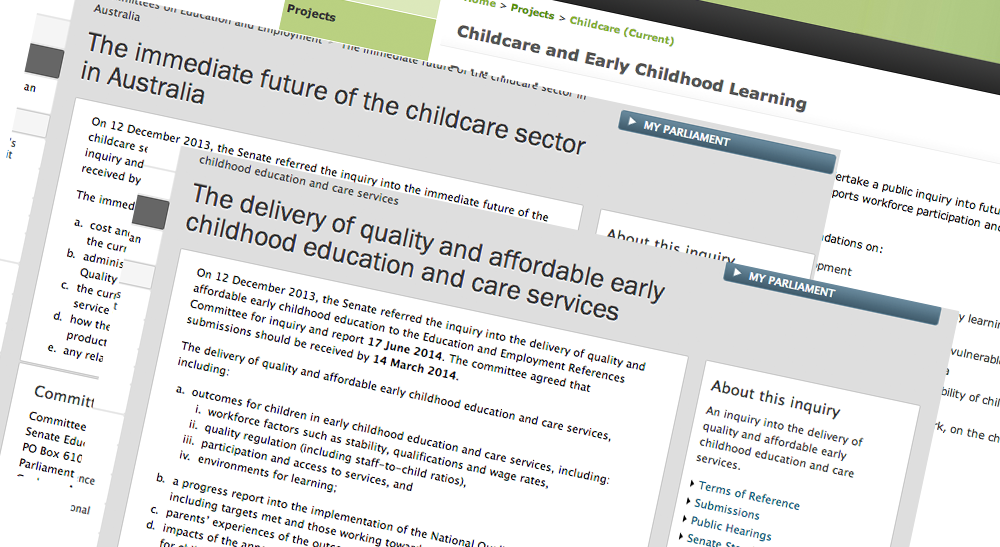
It seems that Government inquiries into early childhood education and care are like Star Wars movies. You spend ages waiting for one to come along, and then all of a sudden three are announced at once.

As well as the high-profile Productivity Commission inquiry into the sector, there are also two separate Senate inquiries running concurrently. Three significant and investigative examinations of Australia’s childcare sector. Clearly there is a huge gap of knowledge in how to best fund and manage childcare in this country, right?

Well actually, no.

There has never been more global attention on the need for investment and serious political focus on the provision of early learning. From James Heckman’s ground-breaking research in the United States, to the OECD’s own global economic assessments, and analysis of our own long-term data around children and families such as the AEDI, the evidence-based argument for investment has all but been won.

Ever since Tony Abbott announced his “signature” Paid Parental Leave policy, he’s been told left, right and centre that if he really wants to make an impact on women’s workforce participation, then $5.5 billion would be far better directed into childcare.

Three inquiries, or thirteen, or thirty, won’t tell us anything we don’t already know about investment in the early years. The inquiries aren’t about the economics of the issue, but about the politics.

Particularly with the Productivity Commission Inquiry, the Government has already stated that increased investment is off the table. This is stunning, given that the major reform that is needed is significantly more investment.

The inquiries will all have similar recommendations – a reformed system could have incredible benefits for children, families and communities. But the Government has already let us know that is not going to be happening.

They can hold all the inquiries they want, but until funding childcare becomes a budgetary priority, fiddling around the margins will have marginal impact.

But don’t take my word for it. Feel free to hold an inquiry or three.