Categories
Advocacy Blog

High-profile advocacy is being successfully run internationally – but not in Australia

Big Steps Day crowd in Garema Place, Canberra

2014 is a huge year for early childhood education in Australia – so now seems like a good time to ask why Australian advocacy for early learning is not working.

The global profile of early childhood education has probably never been higher. Whether it’s universal access, workforce participation for women and the resultant economic benefits, or the proven link between high quality early learning and addressing structural disadvantage for children, the case to focus policy and budgets on young children is being made all over the world.

Just to pick a few examples, the United Kingdom is having an active political discussion on the merits of universal childcare, which will be one of the key issues of the upcoming 2015 General Election.

President Barrack Obama has also highlighted early childhood education as a priority in his second and final term of office, while former Secretary of State (and very possibly the next President of the US) Hillary Clinton is spearheading a huge advocacy push called Too Small to Fail.

Canadian advocates have been running a long-term, targeted and very savvy campaign targeting local councils and the national Government – The Plan for $10/Day Child Care.

Smart, focused and high-profile campaigns are being successfully run internationally. The same cannot be said for Australia.

This is not to say there are not excellent advocates and advocacy organisations that are operating in Australia – there certainly are.

But in terms of scale, scope and recognition to the general public? Nothing on the scale of any of the international examples.

This is interesting for a number of reasons. Firstly, Australia faces many of the same political and social challenges as the countries listed above – sluggish economies, challenges to workforce participation and rising burden of cost of childcare to families.

We also know from Australian data that 1 in 4 children are starting formal schooling with a developmental delay.

The rising costs of ECEC, issues with availability and a new push for quality are regular items in the media. The conditions are perfect for a clear advocacy campaign to cut through.

But nothing has. There is no clarion call for universal access to early childhood services – individuals are calling for it, but only as individual voices lost in a swirl of op-eds and half-baked ideas about importing nanny-servants.

The Big Steps campaign has enjoyed publicity and even a significant victory – but its target is narrow (professional wages) and comes with the baggage of being a union campaign, fairly or unfairly.

A new player on the block is The Parenthood, a social-media-driven network of families advocating on a number of issues. It’s too soon to effectively judge this group, but it’s important to remember that at this stage The Parenthood (despite some media attention) have not yet demonstrated they have broken through to the wider community.

Their most recent campaign to quarantine preschool funding has only attracted just over 1300 signatures so far. Not insignificant, but not game-changing.

Hard as it may be to admit, the most consistently clear, targeted and successful advocacy on ECEC issues has come from Gwynn Bridge and the Australian Childcare Alliance.

They are the go-to group for the media, have a close relationship with the most senior decision-maker in our sector Assistant Minister Sussan Ley, and have effectively and in all likelihood irrevocably set a significant portion of the sector against quality reforms and the raising of standards for centres.

Like it or not, advocates for high-quality, accessible and child-focused ECEC need to learn from Ms. Bridge and her organisation, and they will need to do it quickly.

The sector has been beset by fragmentation and a lack of collaboration. Reforms in the 1990s and early 2000s turned early learning into a market-based free-for-all. Community organisations who should be natural partners on this issue instead compete for government tenders and grants.

The submissions to the Productivity Commission Inquiry into the sector revealed a frightening lack of consensus amongst early childhood organisations and stakeholders, and more broadly in the community demonstrated the lack of a single “vision” to reach for.

Instead of the community having a smart, simple campaign they could latch on to, we’re stuck with whatever ridiculous thought bubble the latest Think Tank has just thrown up.

The fundamental reason that we don’t have a banner to rally around is that no-one could agree what colour it would be, let alone what would be written on it.

Internationally, Australia is viewed as fairly progressive – we did after all briefly elect an atheist, unmarried woman as our leader.

But everything I know about Australia tells a different story – a country with a deep, long and embedded relationship with conservatism.

The same country – and the same political party – that elected Julia Gillard mercilessly and callously cut her down, with more than a whiff of relaxed sighs when two successive white men in suits (and idiotic grins) took her place.

The main progressive party in this country re-opened Manus Island and signed the PNG re-settlement deal. It has supported ever-encroaching freedom for intelligence agencies to collect information on us.

In the last Parliament, only 48 MPs out of 150 voted for marriage equality. 26 of the “No” votes came from the ALP. To contrast, conservative governments in New Zealand and the United Kingdom have implemented laws allowing for gay marriage.

The case for high-quality, accessible and affordable childcare strikes on a deeply conservative nerve as I have written before. Conservative values say the kids stay at home with Mum. Universal childcare has the potential to undermine the much-hyped about “family unit”, with Mum, Dad and the little kiddies.

Despite a laid-back, “all good” image we project abroad, Australia has demonstrated time and time again that we are conservative nation that occasionally (and reluctantly) dabbles with progressive notions. Early childhood advocates will need to be strategic and persistent to defeat that.

But there is a slight silver lining – when Australia does go progressive, it goes hard. Medicare is a good example. Free, universal healthcare is not going anywhere, no matter how conservative the Government of the day may be.

Progressive wins, when they are completely won, are fully embedded. Universal early childhood education could be the next big win.

I’ve identified the problems – now what are the solutions?

Large early childhood organisations need to come together across the country for large-scale and targeted political advocacy.

Getting those organisations to agree on every point will never happen – so it needs to be around something simple. For me, the focal point has to be the continuation of the NQF in its current form.

Removing the points of contention and coming together around this issue is not impossible, but could have significant impact. A coalition of providers in Australia could be a powerful political force – now we just have to see if they realise it.
Categories
Blog Policy

Will the ghost of the EYQF continue to haunt the Government?

eyqflabor

The Coalition Government has found much to fault the previous Labor Government for, not least in its handling of early childhood education and care.

They’ve managed a tepid and limp hand clap for the creation and implementation of the National Quality Framework, which provides a national minimum standard for this work for the very first time.

Services are however, apparently “drowning in red tape” and quaking in fear from the “dead hand of government regulation”. The way the Coalition tells it, the last six years in ECEC have basically been a horror movie that the public has at last been able to walk out on.

Labor, those socialist fiends, have apparently just been throwing money at problems plaguing the sector – which presumably means that services are drowning in both red tape and money. A weird way to go.

But it appears that nothing has made the now grown-up and serious Government more disappointed than the handling of the Early Years Quality Fund.

“It was unfair,” they cried. “It was inequitable!” they wailed. “It was a lot of money we’d rather not spend on educators!” they murmured quietly on their way back to their offices.

Now, to be fair, it was unfair and it was inequitable. Please see previous blog rants for anything more on that.

But it placed the Government in the tricky position of trying to tight-walk between their burning desire to erase the last six years of history from the books, and the somewhat uncomfortable image of ripping away a small pay increase from people who work with young children.

To address this fairness and inequity, the Government has instead redirected the $300 million fund to “professional development” to the entire sector.

Well, $300 million minus the amount that had already been contracted out to organisations who, when politely asked by politicians on hundreds of thousands of dollars a year (plus entitlements and apparently any large bookshelves they feel they might need) to return the money they were going to give to some of the lowest-paid workers in Australia, shocking said “No”.

According to the Department of Education, money should be rolling out to spend on professional development pretty soon. There is not a lot of information available on requirements, processes or obligations on services concerning the money.

But a more basic question has possibly not been asked – can the Government even do what they are proposing to do?

Let’s have a look at what we know.

The EYQF was legislated – it passed the House of Representatives and the Senate and became law. This means the money allocated for it can only be used for the prescribed, legislated purpose – i.e. professional wages.

From an interview on ABC’s 730 program in December:

SUSSAN LEY: …the special account Labor created only targeted long-day-care centres and only targeted a small proportion of those.

LEIGH SALES: But you’re in charge now. You’ve got the $300 million?

SUSSAN LEY: Well, we are stuck with their legislation and I don’t propose to send the legislation back to the Parliament.

The context of the conversation was that Leigh Sales had suggested to Sussan Ley if the issue was one of equity, why not just redistribute the funding to the entire sector. In this section, Sussan Ley has suggested that this was not possible due to the nature of the legislation.

The actual legislation itself – The Early Years Quality Fund Special Account Bill 2013 – is available here and is pretty clear. It’s a riveting document with an almost spectacular lack of detail, but the key point is Section 7:

Purpose of the Early Years Quality Fund Special Account:


The purpose of the Early Years Quality Fund Special Account is to provide funding to approved centre based long day care services, to be used exclusively for paying remuneration, and other employment-related costs and expenses, in relation to employees in the early childhood education and care sector.

Based on the evidence, it would appear to be legislatively impossible for the Assistant Minister to do as she is proposing, which is to redirect the funding legislated in this Bill.

Yet that appears to be exactly what is occurring, with apparently no objection from either the Opposition or United Voice.

The Bill does state that funds can be used for professional wages and “for other employment-related costs and expenses, in relation to employees in the early childhood education and care sector.” This, however, hardly directly equates to professional development.

I have contacted the Assistant Minister with these questions and, based on my previous communications with her office, will receive a reply from her Department in 2-3 months.

But it perhaps needs to be asked of the other political players in ECEC why this rather substantial question on whether the Government can do what they are proposing to do has not been asked in Parliament.

Editors Note: Grateful thanks are given to Karl Hessian and Lisa Bryant for their research and assistance in this post. You can (and should) follow them both on Twitter by clicking on their names.

Categories
Blog News Policy

Government clarifies position on wages for early childhood educators

Big Steps Day crowd in Garema Place, Canberra

Now that submissions to the Productivity Commission’s Inquiry into Child Care and Early Learning have closed, attention has turned to another big event in early childhood education and care in 2014.

Fair Work Australia will be making a ruling on the wages of educators around the middle of the year. One of the things that will decide the final ruling will be whether the wages of educators are chronically low due to the feminisation of the sector – essentially they are lowly paid as the role has been viewed primarily as women’s work, traditionally done for free.

The previous ALP Government referred the case to Fair Work Australia as part of its response to the Big Steps campaign. They also committed funds to a Pay Equity Unit within FWA to assist with the application.

Throughout last year, and the 2013 election, the Coalition supported the referral of the wages issue to Fair Work Australia. Sussan Ley, the Assistant Minister for Education, said in December “Let’s let the Fair Work Commission do its work and come up with a sustainable increase for everybody.”.

At the time, this was a simple political deflection to avoid being perceived as attacking educators.

Now that the FWA decision is in the not-too-distant future, it appears that the Government may be changing its approach somewhat.

The Australian has reported on a Federal Government submission to FWA, where they have warned that granting wage increases to the sector could have negative flow-on effects to other industries.

From The Australian:

In a submission to the commission lodged late yesterday, the government said the tribunal’s task was to redress any gender-based differences in pay, not “undertake an exercise in comparative wage justice”.

The Government seems to be trying to make the point that FWA is not empowered to compare wages between different sectors or industries, but only to resolve specific gender issues within a specific sector.

This is deliberate attempt to refocus the case in a direction far more likely to lead to a negative verdict.

The evidence is clear and irrefutable that early childhood educators are underpaid primarily due to the feminisation of the sector. On current figures, only 3% of the sector is male.

FWA’s decision that wages were unfairly low for reasons of gender in the social and community sector case was in the context of a sector that employs around 15-20% of men.

On the strength of that alone, the case seems relatively open and shut.

What the Government appears to be trying to do is direct FWA to not compare between the ECEC sector and more diversely-represented sectors (or even male-dominated sectors), as there can only be one conclusion drawn from those comparisons.

Sections of the sector have reacted negatively to the Government’s position. Kate Ellis, the Shadow Minister for Early Childhood, Child Care and Youth, said that “The Abbott Government said to educators time and time again, if you want a pay rise, take it to the Fair Work Commission. But educators never expected their own government would speak out against them getting the wage they deserve. This is nothing but a cruel deception and a tricky political game and the cost is borne on low paid workers.”

It is important to remember, however, that FWA is an entirely independent body and is not directed by the Government.

The Government undoubtedly would prefer that in the current political climate of a “budget emergency”, they are not left footing the bill for a wage increase that could be anywhere up to $2 billion.

The Government are trying to encourage FWA to shift the goalposts into a position more favourable to them – but that is no guarantee that it will happen.

A clear case can be made that a culture of undervaluing the work of women in our society has had the long-term impact of keeping the wages of professional educators and teachers in the ECEC sector artificially low.

All that remains is for that case to be forcefully made, and for FWA to hand down its decision.

Categories
Blog Policy

Where will the Government be heading on early childhood education?

ac-abbott-defcon-20130826061341936952-620x0

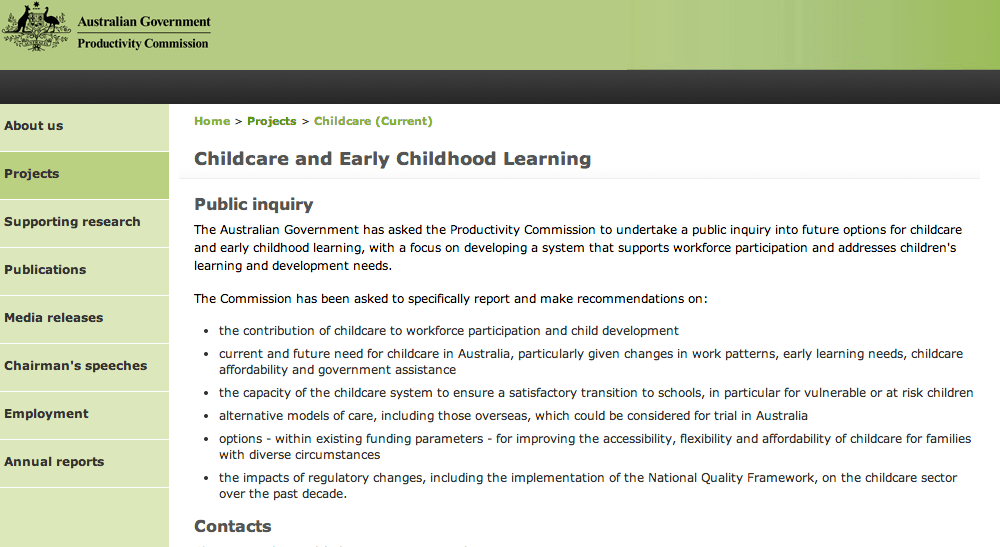
The due date for submissions to the Productivity Commission’s Inquiry into Childcare and Early Learning has now passed, and the Commission now begins the process of preparing a draft report for the Federal Government. This draft report will be available in early July.

It is worth discussing the likely paths that the Federal Government will take when the Commission delivers its final report at the end of October.

The National Quality Framework (NQF) was a national push to set baseline standards for children’s education and care. It was a Federal Labor initiative but was signed up to, and continues to be implemented by, State and Territory Governments of both sides of politics.

It set significant new standards for qualification requirements, ratios and supporting children’s learning to be phased in between 2012 and 2020.

Despite some showing some limited support during the 2013 election campaign, the Government has generally attacked the quality reforms as being an unnecessary regulatory burden and described centres as drowning “in a sea of red tape”.

The Assistant Minister for Education Sussan Ley has directly linked the implementation of the NQF to a sharp increase in fees for families.

The biggest political issue in the children’s education and care sector is affordability. Between June 2012 and June 2013 there was a 45c rise in the average hourly fee for children’s services in Australia, on top of similar increases in the preceding years.

When in Opposition, the Coalition used the fee increases to consistently attack the Labor Government.

It is clear from the most recent data that the out-of-pocket spend for families remained at a relatively low level of 8-9% of total income across all income brackets, due to Labor’s increase in the Child Care Rebate from 30% to 50%.

But due in part the byzantine nature of the subsidy system and an effective political campaign of negativity from the Opposition, the narrative on runaway fee increases struck a chord with families.

The Coalition has strived to continue that narrative in Government, firmly placing the current issues of affordability onto the Labor Party.

The Government will surely be aware however that this will only work for a short period of time. Politically, this issue will soon be owned solely by them.

The Government has so far resisted committing to any specifics on changes to the childcare sector, stating that they are waiting for the Productivity Commission to provide their final report.

But when it comes, the Government will need to provide a clear and detailed response to the issues facing the sector.

The key funding lever for the Government is the Child Care Benefit and Child Care Rebate subsidies (both introduced by the Howard Government).

They may seem completely unconnected, but recent refusals by the Government to provide industry assistance to Holden and SPC Ardmona may actually provide us with some insight into their thinking on the CCB/CCR subsidy.

The decision to deny assistance packages to those companies has demonstrated that the Government is prepared to make tough decisions on spending taxpayer money to support businesses.

The childcare sector is currently a majority private enterprise, with private operators making over two-thirds of the sector. The rest are run as not-for-profit community services.

The CCB/CCR subsidy essentially acts as indirect industry assistance to the operators of children’s services. Approximately $5 billion a year is spent on that subsidy – a not insignificant amount of money. Is it possible that the Government would consider lowering that amount of subsidy?

This would come at a huge political cost. In the June quarter 2013 over 742,000 families accessed some form of formal childcare.

Having spent their time drawing attention to the affordability issue as a political weapon, the onus is now on the Government to take steps to address it.

To complicate matters, they have instructed the Productivity Commission that any suggestions they put forward must be within “current funding parameters”. This leaves them with only a few options.

Either the CCB/CCR subsidy is lowered, a politically “courageous” decision as Sir Humphrey might put it, or the quality standards currently being implemented by the National Quality Framework are drastically rolled back.

Given the political considerations, the second option is far more likely. Which puts a lot of the Government’s statements in the media into context.

The focus on “over-regulation” and “red tape” in the media since the implementation on the NQF, and its intense focus over recent weeks, can be seen as laying groundwork for a large-scale downgrading of those reforms.

They can be sold not as a cut on quality outcomes for children, but as a cut on red tape.

This would be a disastrous outcome for Australia’s children. Advocates for quality education and care have stressed the importance of taking early learning seriously as in investment in Australia’s future prosperity.

It would be shame indeed if political expediency hampers a once-in-a-generation opportunity for the Productivity Commission Inquiry to recommend sweeping structural reforms to quality and affordability – without choosing one over the other.

Categories
News Policy

Affordability the battleground for 2014

The June 2013 quarterly from the Department of Education on ECEC will be available later today [UPDATE: is now available here], and the political brawl of affordability has already begun according to Judith Ireland.

The Education Department’s June 2013 quarter report on childcare and early learning, released on Monday, shows the average fee, per hour, of long day care was $7.50 between April and June last year, when Labor was still in power – up from a $5 average in the September quarter of 2007, at the end of the Howard government.

”Childcare now costs the average parent about an extra $70 per week per child than it did before Labor took office – for the exact same number of hours,” Assistant Education Minister Sussan Ley said. ”That’s extremely concerning.”

Sussan Ley and the Government are of course delighted with these figures and we will no doubt be hearing a lot of them over the next few months as the Productivity Commission does its work.

Kate Ellis has of course hit back at the claim, accusing the Government of being “sneaky” with the figures (but with no further details, at least in the media at the moment).

Labor raised the Child Care Rebate from 30% to 50%, and have always used this as their standard defence against political attack on this issue. It seems unlikely that this will work this time.

As Sam Page from Early Childhood Australia points out:

Early Childhood Australia chief executive Samantha Page said with wages making up about 80 per cent of long day care costs, wage increases over the six-year period would account for a ”fair proportion” of the cost change. But she said Labor had not adequately funded a 2012 national quality framework, that included reforms such as standardising child-to-staff ratios.

Labor’s failure to adequately prepare for the implementation of the National Quality Framework, and the resultant impact on operational costs for centres and therefore fees, is now reaping the obvious political dividends.

As I’ve written before, the National Quality Framework was a significant and critical reform that was carried out by Labor. But Ministers Kate Ellis and Peter Garrett both seemed completely oblivious to the broader landscape of ECEC.

Raising the CCR was supposed to be their cover for affordability and cost-of-living attacks from the then-Opposition. But as was inevitable, this encouraged a huge uptake in the usage of children’s services, long day care in particular. This pushed up waiting lists, particularly in the 0-2 age range, leading to regular media reports on inaccessibility.

The new qualification standards by themselves were always going to see fee increases for a sector that has always struggled to recruit and retain qualified staff. The signature failure of the NQF implementation was the seeming desire of the ALP Government to pretend there ever was a staffing problem (until in an election year it became politically convenient to finally realise). A funding and training package for this issue, that covered the entire sector, should have been rolled out in parallel with the NQF.

The ALP will spend 2014 being hit repeatedly over the head with the accessibility and affordability issue. They spent their time in Government pretending that quality wouldn’t cost anything. Will they spend their time in Opposition developing an early childhood education policy that can structurally address these issues?

The Government will of course continue their attacks – but this potentially leaves them with a very tricky problem.

Going on and on about affordability particularly rather implies that they think something should be done about it. At this stage they are refusing to commit to anything before the outcome of the Productivity Commission report.

But by raising this as a regular issue for the public, the Government will at some stage be held responsible for it. They will have to look at measures to improve affordability. But this Government is determined to be seen as economic conservatives – it seems unlikely that further increases to the CCR or CCB would be on the cards.

But what are their options? In their terms of reference the Productivity Commission has been instructed that any recommendations must be “within current funding parameters”.

This leaves the troubling conclusion that the only way to reduce fees for families is to roll back quality standards, particularly qualification requirements and ratios.

If that’s the case, we’re looking at the groundwork for that announcement today.

Categories
Advocacy News

UNICEF release State of the World’s Children Report

UNICEF has released its annual “State of the World’s Children Report”.

Thirty years have passed since The State of the World’s Children began to publish tables of standardized global and national statistics aimed at providing a detailed picture of children’s circumstances.

Much has changed in the decades since the first indicators of child well-being were presented. But the basic idea has not: consistent, credible data about children’s situations are critical to the improvement of their lives – and indispensable to realizing the rights of every child.

Data continue to support advocacy and action on behalf of the world’s 2.2 billion children, providing governments with facts on which to base decisions and actions to improve children’s lives. And new ways of collecting and using data will help target investments and interventions to reach the most vulnerable children.

As usual, the report includes some incredible statistics on children’s development, education and how their rights are being upheld (or otherwise).

The site includes some fantastic interactive explorations of the numbers that make up the global picture for children. Some of the incredible statistics include:

  • 1 in 5 children die before the age of 5 in Sierra Leone;
  • In half of the world’s countries, 80% of children 2–14 years old have been subjected to violent discipline

The report is interesting to read alongside “Children’s Chances: How Countries Can Move From Surviving to Thriving”, which also presents a wealth of data on how countries are progressing with children’s rights.

Categories
Blog

Lighting Fires is back for 2014!

Welcome back to Lighting Fires for 2014!

Thanks to all those who shared, commented and engaged in discussions on the blog (and on Twitter and Facebook). It’s been great fun exploring the political and policy dimensions of early childhood education in Australia.

I’m excited to keep up with the writing this year, as 2014 is going to a seminal year for the sector. 2014 will see:

  • The Productivity Commission report into Childcare and Learning;
  • The ACECQA Review; and
  • The Wage Equity Case for Fair Work Australia.

There has never been a more important time for the sector to be united and professional in its advocacy for children and their human rights to education.

I’m looking forward to being part of the many conversations that will be happening this year. Please subscribe to the blog to keep up with my posts, and please follow me on my second home – Twitter! You can find me @liammcnicholas.

I also have a Facebook page this year, so please join the conversation there as well.

I’d also love to open up the blog to other commentators, advocates and educators in the sector. If you’d like to post an article or opinion on the site, please contact me at liam.mcnicholas@gmail.com.

Here’s to a big year for ECEC in 2014!

Categories
Blog Policy

EYQF ends, as it was always going to, in complete farce

Ending months of speculation, Assistant Minister for Education Sussan Ley today announced that the Government would seek to redirect $300 million committed to the Early Years Quality Fund into “professional development” for the entire sector.

“…this new programme will specifically target professional development opportunities that will provide improved access to childcare and early learning career paths for educators.

“This will in turn help retain staff in the sector and meet the improved education standards required under the National Quality Framework.

“This is shaping up to be the biggest public investment in professional development in the childcare sector’s history. I encourage all operators to recognise this once in a generation opportunity to improve the skills of some of our lowest paid workers.”

An ignoble end to an inequitable and hastily cobbled-together election year throw-of-the-dice.

I have advocated against this fund since it was first publicly announced in April. At the time, I stated:

I believe that this funding package has the potential to disastrously undermine the Early Childhood Education sector and the campaign for professional wages.

So here we find ourselves. It gives me no pleasure whatsoever to be proved right.

An independent report from PricewaterhouseCoopers has slammed the Fund. This will undoubtedly be read by supporters of the fund as unfair and political.

It’s worth pointing out, however, that PricewaterhouseCoopers (PwC) have had an ongoing commitment to examining and reporting on the early childhood education and care sector, and have been overwhelmingly progressive. They even advocated to Government a “Gonski-style” funding model of ECEC, where children are funded at a base level and loadings are applied for children experiencing vulnerabilities.

Hardly a Conservative mouthpiece.

The report accuses the Government and United Voice of using the Fund as a thinly-veiled means to drive up union membership. Hardly a huge scandal that a Union would seek to increase its membership, but the use of taxpayer funds to do so is obviously of concern.

From my point of view, I believe that the Union have in the majority of cases acted in the best interests of some of the lowest-paid people in this country.

It is however, absolutely true that in some cases the “marketing” of the EYQF was handled badly by United Voice. PwC claim to have evidence of union delegates harassing services to become members, or they would not receive money from the Fund.

I will not give specific details, but I can confirm from my own experience that in some cases that absolutely did happen.

(Not, I hasten to add, in the ACT where the United Voice branch has always worked collaboratively and effectively with the ECEC workforce).

Some in the sector have raised the point that surely it’s good if more educators join the Union? Absolutely. But holding a bucket of money over their heads and essentially telling them “join us or you don’t get it” is immoral and disgusting behaviour.

The structural issues with the sector mean that Union membership is not going to follow the same trajectory as teachers, or nurses. The overwhelming influence of market forces, and a much lower level of community respect means that there is not going to be some huge upsurge in membership.

Particularly when a Labor Government announces a fund that will only to go to less than half of the sector, and is clearly aimed at keeping private operators out.

Not only that, but then splitting the fund into two buckets (at the very last minute) was an absolutely outrageous and incomprehensible decision. Making an already inequitable policy even more inequitable? That takes a level of political incompetence I can barely conceive of.

And this is the fundamental problem with the entire Fund, and why it was always going to end in this farce. No matter what the intention, no matter what the strategy, no matter what the “long-term plan”, funding only 40% of the sector was a despicable and grossly unfair policy decision.

At the centre of all these policy discussions are lowly-paid educators, the majority of whom will now be rightly furious. They have spend the last 7 months being systematically treated like fools, by Labor and Liberal politicians.

From my point of view (for what it’s worth), all of the contracts, conditional or otherwise, should have been honoured by Tony Abbott. That was the election commitment.

The Government will spend the money anyway, on some nebulous “professional development” fund. No further details, of course. I particularly like the notion that the Government would quite like those will be getting money through EYQF contracts to pay it back, pretty please. That should go extremely well.

I actually completely agree with taking the entire $300 million and spending it on the entire sector. It’s what should have been done in the first place.

But the new Government has demonstrated that, just as with the previous Government, they are prepared to play low politics with ECEC.

The focus now has to shift to the Productivity Commission Inquiry, and the Wage Equity Case.

Let the EYQF stand as a reminder to advocates for the sector to be careful what you wish for – and to remember that forgoing our principles of equity because a small bucket of money appears will always end as the Fund has ended today. In embarrassing farce.

Categories
Blog Policy

Terms of reference should be sounding alarm bells

On Sunday November 17, the Federal Government formally launched and announced the terms of reference for the Productivity Commission’s  “Inquiry into Child Care and Early Childhood Learning”.

Throughout the Labor Government’s six-year term in office, the Coalition opposition regularly attacked their changes to the early childhood education and care (childcare) sector

Labor convinced all states and territories to sign up, through COAG, to the National Quality Framework (NQF) for early childhood education and care (ECEC). This was a significant achievement, and was an attempt to unify disparate and complicated state-based regulation and oversight.

The principle objectives of the NQF were a concern for the heavyweight players in the ECEC sector, the for-profit private operators. Lower staff-to-child ratios and higher qualification requirements for early childhood educators would directly eat in to their potential profits.

The Coalition gladly took up the banner for the private operators, running ridiculous lines on “the burden of red tape” and “the dead hand of Government regulation”.

For those who take early childhood education seriously, and not as an excuse to make a quick buck, the NQF has drastically streamlined and reduced regulation and paperwork.

This is clearly evident to those of us who managed services in the wildly divergent and complicated system of the National Childcare Accreditation Council, pre-2012.

As promised in the lead up to the 2013 Election, the newly elected Coalition Government will be tasking the Productivity Commission to look into the state of ECEC in Australia. It will report back in October 2014.

Despite assurances from the Government that they support the objectives of the NQF in regards to children’s learning, the Government’s stated intentions in the terms of reference should be ringing major alarm bells for families, educators and early childhood education advocates.

The terms of reference and scope of the inquiry clearly demonstrate that the Government is only viewing the ECEC sector through the very narrow and damaging prism of workforce participation and economic imperatives.

They state it clearly themselves: “We want to ensure that Australia has a system that provides a safe, nurturing environment for children, but which also meets the working needs of families.”

The current Government longs for the days when “daycare” was provided by “nice old ladies” for the love of it.

With the greatest of respect to nice old ladies, those days are over.

Early childhood education and care is about more than a “safe, nurturing environment”. It is a place where children can learn and play socially and safely, developing the skills that will set them up for success in future learning.

Where early childhood education and early learning are mentioned at all in the Government’s announcement, it is far down the list on priorities.

To take a brief look at the section ‘the current and future need for childcare’, “hours parents work” ranks No. 1 on the list.

The “needs of vulnerable or at-risk children”? No. 11.

Could there be a clearer indication of this Government’s priorities?

The Government has also tasked the Productivity Commission to only offer recommendations “within current funding parameters”, effectively ruling out any increase in funding to the sector.

With a sector beset by wages and conditions that should be a national scandal, working with children at the most important stage of their development, this is unacceptable.

The Government’s repeated mantra on “red tape” is also a huge concern. Clear regulation and oversight is essential to the safety and wellbeing of children.

You need only look at systems in the United States and Ireland to see where a desire to not have “unnecessary bureaucracy” has directly endangered the safety, or even the lives, of children.

The inquiry will also be examining the ability of the ECEC sector to meet the “needs of today’s families and today’s economy”.

I am always interested in how it is the community who has to be more “flexible” to business interests.

I’m not sure where the Government’s entreaties to the business community to be more “flexible” to the needs of families are.

Yes, the growing amount of shift and casual work is undoubtedly causing issues for some families (although, as is always the case with this argument, no-one actually has any data to prove it).

But why do we automatically leap to the assumption that the community systems around that issue must change and adapt? Why is there not a national discussion on the business community’s role in supporting families?

The Government’s determination to work within the current market-based system is disappointing, but unsurprising. This was a key “win” for the Howard Government, turning over the education and wellbeing of Australia’s children to profiteering private operators.

The deference to market-based solutions to community and social issues is so stupid as to be hardly worth rebutting.

All that needs to be said is that if the market was capable of providing this “service” to the community in an adequate and cost-effective way, why on earth are there two generous and expensive subsidies available to families (the Child Care Benefit and the Child Care Rebate)?

The inquiry does have the potential to identify systemic issues with the sector, which advocates have been identifying for decades.

Any reasonable examination of the current structure of ECEC can only discover that it is fundamentally flawed. This could be extremely positive for the sector, as the Government can hardly ignore the report it asked for.

The Coalition (and even the Labor Government, who lacked the imagination to fundamentally shake-up the system) have always viewed turning the sector over to the private providers as positive.

It is entirely likely that the Productivity Commission will actually report that it was a huge error that has fundamentally disadvantaged children, families and the community for years.

There will already be a million eyes rolling as they read this, but the fundamental question needs to be asked. Do we want to live in an economy? Or do we want to live in a society?

So ECEC can increase workforce participation. Great. To what end?

This may come as a shock, but I don’t carry out my work as a teacher with children to incrementally increase Australia’s GDP output.

I can think of a number of reasons why ECEC is vital to our community: setting children up to succeed in school and life; lifting children and families out of generational vulnerability; closing the gap between Indigenous and non-Indigenous people.

Preparing children to be good little contributors to the economy is not high up on my list.

Sunday’s announcement needs to be a clarion call to arms for early childhood education advocates. The lines have been drawn.

Categories
News Policy

Terms of reference out for Productivity Commission inquiry

The Federal Government today formally announced the “terms of reference” and scope for next year’s Productivity Commission into “Child Care and Early Childhood Learning”.

The Government is delivering on its priority commitment to task the Productivity Commission with an inquiry into how the child care system can be made more flexible, affordable and accessible.

The Inquiry will identify how the current system can be improved to make it more responsive to the needs of parents.

We want to ensure that Australia has a system that provides a safe, nurturing environment for children, but which also meets the working needs of families.

Our child care system should be responsive to the needs of today’s families and today’s economy, not the five-day 9am-5pm working week of last century.

I’ll have a longer article up on this later this week, but this should be sounding alarm bells for all advocates for early childhood education.

The announcement makes clear that workforce participation and economic imperatives are the focus for this Government.

The sector will need to be putting up some strategic and sustained advocacy in the face of this.