Categories
News Policy

Affordability the battleground for 2014

The June 2013 quarterly from the Department of Education on ECEC will be available later today [UPDATE: is now available here], and the political brawl of affordability has already begun according to Judith Ireland.

The Education Department’s June 2013 quarter report on childcare and early learning, released on Monday, shows the average fee, per hour, of long day care was $7.50 between April and June last year, when Labor was still in power – up from a $5 average in the September quarter of 2007, at the end of the Howard government.

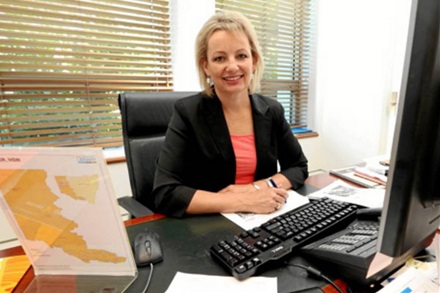
”Childcare now costs the average parent about an extra $70 per week per child than it did before Labor took office – for the exact same number of hours,” Assistant Education Minister Sussan Ley said. ”That’s extremely concerning.”

Sussan Ley and the Government are of course delighted with these figures and we will no doubt be hearing a lot of them over the next few months as the Productivity Commission does its work.

Kate Ellis has of course hit back at the claim, accusing the Government of being “sneaky” with the figures (but with no further details, at least in the media at the moment).

Labor raised the Child Care Rebate from 30% to 50%, and have always used this as their standard defence against political attack on this issue. It seems unlikely that this will work this time.

As Sam Page from Early Childhood Australia points out:

Early Childhood Australia chief executive Samantha Page said with wages making up about 80 per cent of long day care costs, wage increases over the six-year period would account for a ”fair proportion” of the cost change. But she said Labor had not adequately funded a 2012 national quality framework, that included reforms such as standardising child-to-staff ratios.

Labor’s failure to adequately prepare for the implementation of the National Quality Framework, and the resultant impact on operational costs for centres and therefore fees, is now reaping the obvious political dividends.

As I’ve written before, the National Quality Framework was a significant and critical reform that was carried out by Labor. But Ministers Kate Ellis and Peter Garrett both seemed completely oblivious to the broader landscape of ECEC.

Raising the CCR was supposed to be their cover for affordability and cost-of-living attacks from the then-Opposition. But as was inevitable, this encouraged a huge uptake in the usage of children’s services, long day care in particular. This pushed up waiting lists, particularly in the 0-2 age range, leading to regular media reports on inaccessibility.

The new qualification standards by themselves were always going to see fee increases for a sector that has always struggled to recruit and retain qualified staff. The signature failure of the NQF implementation was the seeming desire of the ALP Government to pretend there ever was a staffing problem (until in an election year it became politically convenient to finally realise). A funding and training package for this issue, that covered the entire sector, should have been rolled out in parallel with the NQF.

The ALP will spend 2014 being hit repeatedly over the head with the accessibility and affordability issue. They spent their time in Government pretending that quality wouldn’t cost anything. Will they spend their time in Opposition developing an early childhood education policy that can structurally address these issues?

The Government will of course continue their attacks – but this potentially leaves them with a very tricky problem.

Going on and on about affordability particularly rather implies that they think something should be done about it. At this stage they are refusing to commit to anything before the outcome of the Productivity Commission report.

But by raising this as a regular issue for the public, the Government will at some stage be held responsible for it. They will have to look at measures to improve affordability. But this Government is determined to be seen as economic conservatives – it seems unlikely that further increases to the CCR or CCB would be on the cards.

But what are their options? In their terms of reference the Productivity Commission has been instructed that any recommendations must be “within current funding parameters”.

This leaves the troubling conclusion that the only way to reduce fees for families is to roll back quality standards, particularly qualification requirements and ratios.

If that’s the case, we’re looking at the groundwork for that announcement today.

Categories
News Quality

Can the US make much-needed changes to its ECE sector?

Laura Bornfreund and Conor Williams have examined President Obama’s second-term focus on early childhood education in The Atlantic.

While early education’s policy reality hasn’t lived up to the last five years’ rhetoric, there is some evidence of a silver lining. Think of it like a rail system: it’s as though we’ve spent half a decade designing and laying new high-speed rails linking sparkling, as-yet unused train stations. We’ve invested in shiny, state-of-the-art engines. But we haven’t yet bought fuel or enough cars to serve all of the system’s young “passengers.”

President Obama has another two years of office left, and is facing incredible political hurdles. It remains to be seen if anything more can be achieved on this issue – which is a shame, as it can and must be a vital part of addressing rising inequality in that country.

It stands in contrast to Australia, where in 2014 we could actually be moving backwards on higher standards and greater outcomes for children’s learning and wellbeing.

Categories
Advocacy News

ECA release pre-Budget submission

Early Childhood Australia have publicly released their pre-Budget submission to the Federal Government for the 2014/2015 Budget.

There is good evidence to suggest that early intervention and prevention programs in the areas of
maternal, child and family health; early childhood education and care; and family support programs
can improve outcomes for children, particularly those from disadvantaged backgrounds.

ECA makes this submission to the 2014–15 Budget in the context of the Productivity Commission’s
ongoing Inquiry into Child Care and Early Childhood Learning. ECA has welcomed this root and
branch review of the system. It will enable a thorough look at how the system can best meet
Australia’s needs into the future and there are a number of areas that genuinely need reform.

ECA’s submission features 2 priorities 9 recommendations to the Government as they consider their Budget for the upcoming financial year.

Overall, it is fantastic to see ECA advocating strongly for the full implementation of the National Quality Framework in the face of a concerted campaign by private operators (which ECA also represent) to see it rolled back.

The submission also focuses strongly on the needs of those children and families experiencing the greatest disadvantage and vulnerabilities.

ECA also manages the vital National Quality Standard Professional Learning Program, which has had its funding removed by the Federal Government. It’s a critical resource for the sector at a time when professional standards must rise, so I sincerely hope that ECA and the sector’s advocacy on this sees the program fully restored.

Categories
Blog

Lighting Fires is back for 2014!

Welcome back to Lighting Fires for 2014!

Thanks to all those who shared, commented and engaged in discussions on the blog (and on Twitter and Facebook). It’s been great fun exploring the political and policy dimensions of early childhood education in Australia.

I’m excited to keep up with the writing this year, as 2014 is going to a seminal year for the sector. 2014 will see:

  • The Productivity Commission report into Childcare and Learning;
  • The ACECQA Review; and
  • The Wage Equity Case for Fair Work Australia.

There has never been a more important time for the sector to be united and professional in its advocacy for children and their human rights to education.

I’m looking forward to being part of the many conversations that will be happening this year. Please subscribe to the blog to keep up with my posts, and please follow me on my second home – Twitter! You can find me @liammcnicholas.

I also have a Facebook page this year, so please join the conversation there as well.

I’d also love to open up the blog to other commentators, advocates and educators in the sector. If you’d like to post an article or opinion on the site, please contact me at liam.mcnicholas@gmail.com.

Here’s to a big year for ECEC in 2014!

Categories
Blog Policy

EYQF ends, as it was always going to, in complete farce

Ending months of speculation, Assistant Minister for Education Sussan Ley today announced that the Government would seek to redirect $300 million committed to the Early Years Quality Fund into “professional development” for the entire sector.

“…this new programme will specifically target professional development opportunities that will provide improved access to childcare and early learning career paths for educators.

“This will in turn help retain staff in the sector and meet the improved education standards required under the National Quality Framework.

“This is shaping up to be the biggest public investment in professional development in the childcare sector’s history. I encourage all operators to recognise this once in a generation opportunity to improve the skills of some of our lowest paid workers.”

An ignoble end to an inequitable and hastily cobbled-together election year throw-of-the-dice.

I have advocated against this fund since it was first publicly announced in April. At the time, I stated:

I believe that this funding package has the potential to disastrously undermine the Early Childhood Education sector and the campaign for professional wages.

So here we find ourselves. It gives me no pleasure whatsoever to be proved right.

An independent report from PricewaterhouseCoopers has slammed the Fund. This will undoubtedly be read by supporters of the fund as unfair and political.

It’s worth pointing out, however, that PricewaterhouseCoopers (PwC) have had an ongoing commitment to examining and reporting on the early childhood education and care sector, and have been overwhelmingly progressive. They even advocated to Government a “Gonski-style” funding model of ECEC, where children are funded at a base level and loadings are applied for children experiencing vulnerabilities.

Hardly a Conservative mouthpiece.

The report accuses the Government and United Voice of using the Fund as a thinly-veiled means to drive up union membership. Hardly a huge scandal that a Union would seek to increase its membership, but the use of taxpayer funds to do so is obviously of concern.

From my point of view, I believe that the Union have in the majority of cases acted in the best interests of some of the lowest-paid people in this country.

It is however, absolutely true that in some cases the “marketing” of the EYQF was handled badly by United Voice. PwC claim to have evidence of union delegates harassing services to become members, or they would not receive money from the Fund.

I will not give specific details, but I can confirm from my own experience that in some cases that absolutely did happen.

(Not, I hasten to add, in the ACT where the United Voice branch has always worked collaboratively and effectively with the ECEC workforce).

Some in the sector have raised the point that surely it’s good if more educators join the Union? Absolutely. But holding a bucket of money over their heads and essentially telling them “join us or you don’t get it” is immoral and disgusting behaviour.

The structural issues with the sector mean that Union membership is not going to follow the same trajectory as teachers, or nurses. The overwhelming influence of market forces, and a much lower level of community respect means that there is not going to be some huge upsurge in membership.

Particularly when a Labor Government announces a fund that will only to go to less than half of the sector, and is clearly aimed at keeping private operators out.

Not only that, but then splitting the fund into two buckets (at the very last minute) was an absolutely outrageous and incomprehensible decision. Making an already inequitable policy even more inequitable? That takes a level of political incompetence I can barely conceive of.

And this is the fundamental problem with the entire Fund, and why it was always going to end in this farce. No matter what the intention, no matter what the strategy, no matter what the “long-term plan”, funding only 40% of the sector was a despicable and grossly unfair policy decision.

At the centre of all these policy discussions are lowly-paid educators, the majority of whom will now be rightly furious. They have spend the last 7 months being systematically treated like fools, by Labor and Liberal politicians.

From my point of view (for what it’s worth), all of the contracts, conditional or otherwise, should have been honoured by Tony Abbott. That was the election commitment.

The Government will spend the money anyway, on some nebulous “professional development” fund. No further details, of course. I particularly like the notion that the Government would quite like those will be getting money through EYQF contracts to pay it back, pretty please. That should go extremely well.

I actually completely agree with taking the entire $300 million and spending it on the entire sector. It’s what should have been done in the first place.

But the new Government has demonstrated that, just as with the previous Government, they are prepared to play low politics with ECEC.

The focus now has to shift to the Productivity Commission Inquiry, and the Wage Equity Case.

Let the EYQF stand as a reminder to advocates for the sector to be careful what you wish for – and to remember that forgoing our principles of equity because a small bucket of money appears will always end as the Fund has ended today. In embarrassing farce.

Categories
Advocacy Blog

Letter to Sussan Ley, Assistant Minister for Education

In the light of recent public statements on potential changes to the National Quality Framework, I have written to the Assistant Minister for Education Sussan Ley. I would strongly recommend that advocates for quality children’s education and care do the same. Contact details are here.

To the Honourable Sussan Ley MP,
Assistant Minister for Education

Minister, my name is Liam McNicholas. I am an early childhood teacher working in the Australian Capital Territory.

I have been extremely concerned to read and hear your recent official statements on the early childhood education and care sector. I undertake my role because of the incredible potential to postively affect the lives of children. Not just in the time they are with me and my colleagues, but their entire lives.

An ever-growing body of research consistently demonstrates that there is no more important time in the development of a human being than their first five years. Australia’s early childhood education and care sector has an incredible potential to address inequality for children, and set them up for their future success.

But there is also potential to have negative impacts.

Early childhood educators have some of the worst wages in this country. Turnover of educators is extremely high. There are not enough educators to properly support children, particulary the youngest infants.

Services are not directly funded by the Federal Government, so must always struggle to find a balance between charging enough to do our jobs properly and ensure it is accessible to all families.

In a system with these pressures, the potential for children to be harmed is high. Not just physical or mental harm, but in such a crucial period of their development if there are negative impacts on a child it could follow them their entire life.

It is clearly cruical that we get this work right.

The National Quality Framework has been a successful project in ensuring that there is a national standard on quality for all children accessing an ECEC service. It also holds those services accountable.

It is extremely concering to hear you, and your colleagues, describe it as “drowning in red tape” or a “bureaucratic nightmare”.

Really, Minister? Keeping children safe is too much of a “nightmare” for the services and people you are speaking to?

I’ve worked in the ECEC sector for 12 years. I have always worked for community not-for-profit operations, as I believe this is the only current ethical way to support children’s learning and wellbeing in the sector.

I have been a teacher, a Centre Director and an Area Manager. Regulations are not burdensome, they are the framework that supports us to do our job well.

It forces those in the for-profit sector who would rather just make a quick buck to meet a minmum standard.

My suggestion to you when you meet with people in the sector who complain about “red tape” is to suggest they find another job to do. No-one is forcing them to stay.

If meeting 58 standards is too much like hard work, find something easier to do. Find something that won’t directly impact on the lives of Australia’s youngest citizens.

This work is crucial. It should be hard.

I implore you to show leadership in your new role, Minister. Consult and engage with a wider group of people than the private sector, who do not have the best interests of children at heart – only their profits.

I implore you to stop using easy, damaging and false language like “drowning in red tape”. Are you seriously of the belief that people and organisations working with young children shouldn’t have to fill in a bit of paperwork?

The ratio and qualification requirements at the foundation of the NQF are essential to the ongoing quality improvements in the sector. I will be advocating strongly that they are carried out, and indeed extended.

My motivation for that advocacy is the best interests of children.

I ask you to question what the motivations of those who would halt or wind back the National Quality Framework are.

I doubt children are in there. I am sure dollar signs are.

You have a leadership role in our sector Minister Ley, and I would welcome any opportunities to engage with you on this critical issue.

Yours sincerely

Liam McNicholas

Categories
News Policy

Upcoming changes to ECEC regulations

The Assistant Minister for Education Sussan Ley has issued a press release foreshadowing changes to the National Quality Framework regulatory system.

“The Coalition has a clear position supporting high-quality child care, but it needs to be delivered in a fairer way that doesn’t make it unaffordable and inaccessible for parents and providers,” Ms Ley said.

“The child care industry has said loud and clear that Labor’s increased red tape and regulations are some of the main reasons forcing them to raise fees and we’re listening.

“These changes will be a significant first step in improving the implementation of the National Quality Framework.

There is so much that is alarming in this short press release, it’s hard to know where to begin.

As I have said again and again, the issue of “red tape” is only an issue for people who don’t take their jobs seriously.

 “Currently all operators have to undergo assessment in seven ‘quality areas’ that require compliance with 18 ‘standards’ and 58 ‘elements’ just to receive a quality rating—it’s a bureaucratic nightmare,” Ms Ley said.


Assistant Minister Ley talks about the 58 elements that services have to be assessed against as a “bureaucratic nightmare”. This is absolute nonsense, and needs to be called out as such. The examples of the United States and Ireland demonstrate that a system without oversight directly harms children.

“But if it wasn’t complex enough, none of these regulations are individually weighted to represent their importance, meaning one minor issue could deliver a poor rating across the board.”

I agree that there is a discussion that needs to be had about the assessment and rating process. For many centres it is inequitable. But the standards themselves are great – in fact, the bar should be raised higher in many of them.

No specific changes are mentioned in the press release, but merely promises to “streamline” processes.

It is intimated in the release that there could be changes to qualification requirements and ratios.

Advocates for quality education and care should be concerned. Watch this space.

Categories
Advocacy Blog

2014: The Year of Early Childhood Education and Care

2014 is going to be a huge year for the early childhood education and care sector.

The Productivity Commission has been tasked by the new Federal Government with running an inquiry into the “childcare and early learning” system. There has been no such look into the mechanics of the sector since the 1990s.

Fair Work Australia will be considering a wage equity case for Australia’s early childhood education and care workforce.

ACECQA will be undertaking a full review of the implementation of the National Quality Framework.

Throughout December, I will be launching a new advocacy initiative – Children’s Agenda.

For today, can I ask three things of you.

Follow @ChildrenAgenda on Twitter. “Like” Children’s Agenda on Facebook. Share these both with your friends and colleagues.

2014 will decide the future of early childhood education in this country. The decisions made in this year will impact Australian children, families and educators for decades.

Now is the time to step up, raise your voice, and have your say.

Categories
Blog Policy

Terms of reference should be sounding alarm bells

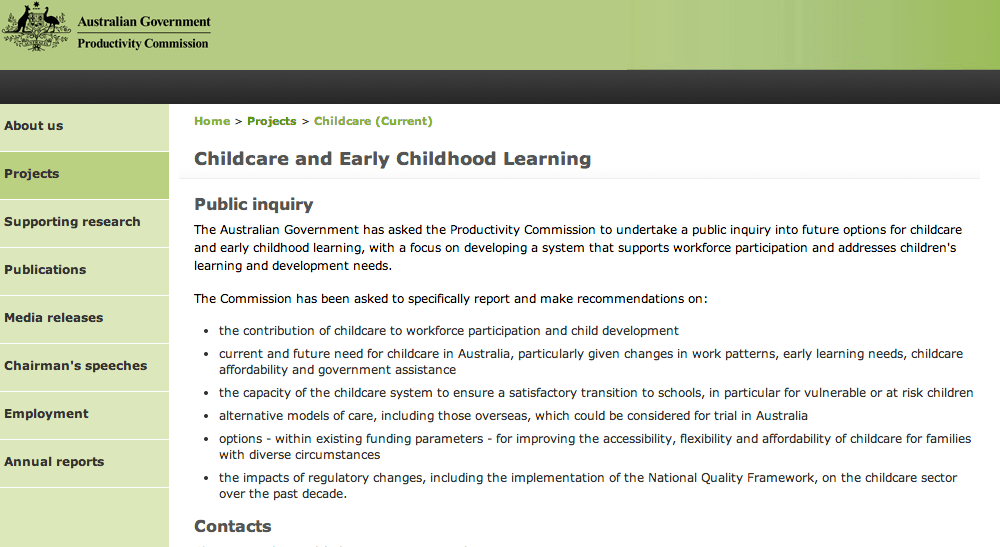
On Sunday November 17, the Federal Government formally launched and announced the terms of reference for the Productivity Commission’s  “Inquiry into Child Care and Early Childhood Learning”.

Throughout the Labor Government’s six-year term in office, the Coalition opposition regularly attacked their changes to the early childhood education and care (childcare) sector

Labor convinced all states and territories to sign up, through COAG, to the National Quality Framework (NQF) for early childhood education and care (ECEC). This was a significant achievement, and was an attempt to unify disparate and complicated state-based regulation and oversight.

The principle objectives of the NQF were a concern for the heavyweight players in the ECEC sector, the for-profit private operators. Lower staff-to-child ratios and higher qualification requirements for early childhood educators would directly eat in to their potential profits.

The Coalition gladly took up the banner for the private operators, running ridiculous lines on “the burden of red tape” and “the dead hand of Government regulation”.

For those who take early childhood education seriously, and not as an excuse to make a quick buck, the NQF has drastically streamlined and reduced regulation and paperwork.

This is clearly evident to those of us who managed services in the wildly divergent and complicated system of the National Childcare Accreditation Council, pre-2012.

As promised in the lead up to the 2013 Election, the newly elected Coalition Government will be tasking the Productivity Commission to look into the state of ECEC in Australia. It will report back in October 2014.

Despite assurances from the Government that they support the objectives of the NQF in regards to children’s learning, the Government’s stated intentions in the terms of reference should be ringing major alarm bells for families, educators and early childhood education advocates.

The terms of reference and scope of the inquiry clearly demonstrate that the Government is only viewing the ECEC sector through the very narrow and damaging prism of workforce participation and economic imperatives.

They state it clearly themselves: “We want to ensure that Australia has a system that provides a safe, nurturing environment for children, but which also meets the working needs of families.”

The current Government longs for the days when “daycare” was provided by “nice old ladies” for the love of it.

With the greatest of respect to nice old ladies, those days are over.

Early childhood education and care is about more than a “safe, nurturing environment”. It is a place where children can learn and play socially and safely, developing the skills that will set them up for success in future learning.

Where early childhood education and early learning are mentioned at all in the Government’s announcement, it is far down the list on priorities.

To take a brief look at the section ‘the current and future need for childcare’, “hours parents work” ranks No. 1 on the list.

The “needs of vulnerable or at-risk children”? No. 11.

Could there be a clearer indication of this Government’s priorities?

The Government has also tasked the Productivity Commission to only offer recommendations “within current funding parameters”, effectively ruling out any increase in funding to the sector.

With a sector beset by wages and conditions that should be a national scandal, working with children at the most important stage of their development, this is unacceptable.

The Government’s repeated mantra on “red tape” is also a huge concern. Clear regulation and oversight is essential to the safety and wellbeing of children.

You need only look at systems in the United States and Ireland to see where a desire to not have “unnecessary bureaucracy” has directly endangered the safety, or even the lives, of children.

The inquiry will also be examining the ability of the ECEC sector to meet the “needs of today’s families and today’s economy”.

I am always interested in how it is the community who has to be more “flexible” to business interests.

I’m not sure where the Government’s entreaties to the business community to be more “flexible” to the needs of families are.

Yes, the growing amount of shift and casual work is undoubtedly causing issues for some families (although, as is always the case with this argument, no-one actually has any data to prove it).

But why do we automatically leap to the assumption that the community systems around that issue must change and adapt? Why is there not a national discussion on the business community’s role in supporting families?

The Government’s determination to work within the current market-based system is disappointing, but unsurprising. This was a key “win” for the Howard Government, turning over the education and wellbeing of Australia’s children to profiteering private operators.

The deference to market-based solutions to community and social issues is so stupid as to be hardly worth rebutting.

All that needs to be said is that if the market was capable of providing this “service” to the community in an adequate and cost-effective way, why on earth are there two generous and expensive subsidies available to families (the Child Care Benefit and the Child Care Rebate)?

The inquiry does have the potential to identify systemic issues with the sector, which advocates have been identifying for decades.

Any reasonable examination of the current structure of ECEC can only discover that it is fundamentally flawed. This could be extremely positive for the sector, as the Government can hardly ignore the report it asked for.

The Coalition (and even the Labor Government, who lacked the imagination to fundamentally shake-up the system) have always viewed turning the sector over to the private providers as positive.

It is entirely likely that the Productivity Commission will actually report that it was a huge error that has fundamentally disadvantaged children, families and the community for years.

There will already be a million eyes rolling as they read this, but the fundamental question needs to be asked. Do we want to live in an economy? Or do we want to live in a society?

So ECEC can increase workforce participation. Great. To what end?

This may come as a shock, but I don’t carry out my work as a teacher with children to incrementally increase Australia’s GDP output.

I can think of a number of reasons why ECEC is vital to our community: setting children up to succeed in school and life; lifting children and families out of generational vulnerability; closing the gap between Indigenous and non-Indigenous people.

Preparing children to be good little contributors to the economy is not high up on my list.

Sunday’s announcement needs to be a clarion call to arms for early childhood education advocates. The lines have been drawn.

Categories
News Policy

Terms of reference out for Productivity Commission inquiry

The Federal Government today formally announced the “terms of reference” and scope for next year’s Productivity Commission into “Child Care and Early Childhood Learning”.

The Government is delivering on its priority commitment to task the Productivity Commission with an inquiry into how the child care system can be made more flexible, affordable and accessible.

The Inquiry will identify how the current system can be improved to make it more responsive to the needs of parents.

We want to ensure that Australia has a system that provides a safe, nurturing environment for children, but which also meets the working needs of families.

Our child care system should be responsive to the needs of today’s families and today’s economy, not the five-day 9am-5pm working week of last century.

I’ll have a longer article up on this later this week, but this should be sounding alarm bells for all advocates for early childhood education.

The announcement makes clear that workforce participation and economic imperatives are the focus for this Government.

The sector will need to be putting up some strategic and sustained advocacy in the face of this.